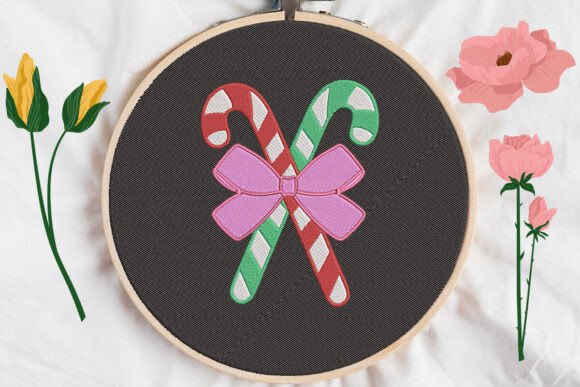
Review: Christmas Candy Cane Embroidery Design
As a designer who has spent countless hours staring at digitizing software and troubleshooting thread breaks, I approach every new machine embroidery design with a mix of curiosity and skepticism. We have all seen those festive graphics that look charming on a screen but turn into a tangled mess of bird nests on fabric. Recently, I pulled up the Christmas Candy Cane Embroidery file to evaluate its potential for my upcoming holiday collection. My goal was not just to admire the aesthetics, but to determine if this asset holds up under the mechanical stress of real-world production.
First Impressions and Visual Personality
The immediate appeal of this design lies in its classic simplicity. The candy cane is an iconic symbol, but rendering it in thread requires a careful balance of color contrast and stitch definition. Upon opening the file, the layout felt balanced and intentional. It does not rely on excessive complexity, which is often a trap for amateur digitizers trying to mimic photographic detail. Instead, it leans into the graphic nature of embroidery.
The mood is undeniably cheerful yet sophisticated enough for boutique applications. It avoids the cartoonish exaggeration found in many free online repositories, opting instead for clean lines that suggest professionalism. For an Etsy seller or small shop owner, this visual clarity is crucial. Customers scrolling through digital storefronts need to instantly recognize the motif, and this design delivers that instant recognition without visual clutter.
Real-World Application: The Sweatshirt Test
To truly understand how a design performs, you must imagine it on a specific substrate. I envisioned this Christmas Candy Cane Embroidery placed on the left chest of a heavy-weight cotton blend sweatshirt. This is a staple item for any craft business during the fourth quarter. The curvature of the chest area presents a challenge for rigid designs, but the proportions here seemed adaptable.
I also considered its use on a canvas tote bag design. Here, the durability of the stitch path becomes paramount. A tote bag undergoes significant friction and weight-bearing stress. If the stitch density is too low, the design will look sparse and cheap. If it is too high, the fabric may pucker or tear. From what I could assess in the preview, the fill areas appeared robust enough to withstand daily use, making it a viable candidate for functional handmade products rather than just decorative wall hangings.
Apparel and Personalized Gifts
Beyond outerwear, this motif shines in custom apparel such as pajama sets. The prompt suggests using the design on Christmas-themed t-shirts or pajama sets, and I agree this is its strongest niche. Imagine a matching family set where the candy cane is embroidered on the pocket or cuff. It adds a subtle touch of holiday embroidery that feels personal and thoughtful. For personalized gift creators, this design serves as an excellent base element. It can be easily combined with monograms or names, provided the spacing allows for additional text without crowding the hoop.
Technical Considerations for Stitching
While the aesthetic is strong, the technical execution determines whether a project succeeds or fails. When working with a red and white color scheme, contrast is key. On dark fabrics, the white portions of the candy cane must be dense enough to prevent the background color from showing through. This often requires a careful selection of thread colors and potentially an underlay strategy that supports the top stitches.
I recommend paying close attention to the stabilizer choice. For stretchy fabrics like jersey knits used in t-shirts, a cut-away stabilizer is non-negotiable to prevent distortion. For woven fabrics like linen tea towels or apron pockets, a tear-away might suffice, but testing is essential. The fabric texture plays a massive role here; a plush velvet will swallow fine details, while a smooth cotton poplin will showcase every satin stitch edge.
Navigating Potential Pitfalls
There are scenarios where this design requires caution. If you are working with a small hoop size, ensure the design scales down without losing integrity. Tiny details can become indistinguishable blobs when reduced too far. Additionally, be wary of using this on highly textured materials like bouclé or thick fleece unless you adjust the stitch length. Long stitches on loose weaves can snag, while short stitches on thick piles may not penetrate fully.
Another consideration is the corner definition. Candy canes have curved ends that transition into straight shafts. Poorly digitized curves can result in jagged edges or thread pulls. I advise running a test stitch-out on scrap fabric similar to your final material. Check for thread breaks at sharp turns and inspect the back of the embroidery for excessive jumping or loose threads. These small details impact the perceived quality of the finished product.
Commercial Viability and Brand Consistency
For commercial embroidery projects, consistency is currency. Buyers trust brands that deliver uniform quality. This design’s clean lines support brand consistency because it reproduces reliably across different machines and operators. Whether you are producing ten units or one hundred, the predictability of the stitch path reduces waste and rework.
Furthermore, the versatility of this digital embroidery file extends to marketing assets. It creates striking printable mockup images for online listings. A crisp, well-stitched candy cane photograph sells the dream of the holiday season more effectively than a flat digital graphic. It signals to the buyer that the small shop product is tangible, high-quality, and made with care.
Final Designer Notes
Before integrating Christmas Candy Cane Embroidery into your workflow, take these practical steps:
- Verify Licensing: Always confirm the license terms. Ensure you have the right to use the design for commercial sales if you plan to sell embroidered patches or apparel.
- Test on Scrap: Never skip the test stitch. Use the same fabric and stabilizer combination you intend to use for the final item.
- Check Thread Contrast: Ensure your white thread is bright and your red is vibrant. Faded threads diminish the festive impact.
- Inspect Density: Look for areas that might be too dense for lightweight fabrics, which could cause puckering.
- Mockup in Black and White: This helps you see the structural integrity of the design without the distraction of color.
In conclusion, this design offers a solid foundation for holiday-themed projects. It balances traditional charm with modern digitizing standards, making it a reliable choice for both hobbyists and professional design assets libraries. With proper preparation and attention to material choices, it can elevate your embroidery project from a simple craft to a cherished keepsake.